
Cleaning, hygiene and safety supplies are central to a well-run restaurant, café, catering operation or home kitchen. The best purchasing plan is not necessarily the one with the most products. It is a clearly organized set of appropriate tools, supported by everyday routines, staff guidance and the manufacturer’s instructions.
This practical buying guide groups the essentials into four collections: Cleaning Supplies & Surface Care, Hand Hygiene & Sanitation, Food Safety & Protective Gear, and Waste Management & Cleaning Tools. These are the same four categories used on the Cleaning, Hygiene & Safety shopping page at Habesha Studio. They are useful for restaurant operators as well as home cooks who want to manage their supplies more thoughtfully.
Start with tasks, surfaces and people—not product labels
Before buying supplies in bulk, map the work performed in your kitchen: receiving ingredients, preparing raw food, cooking, serving, washing dishes and disposing of waste. List the surfaces and equipment involved, from cutting boards and sinks to refrigeration handles and floors. Think about who uses each area, how often it needs attention and what the product manufacturer requires.
Get travel data with Airalo
Install an eSIM before arrival and get mobile data without swapping a physical SIM card.
Cleaning and disinfecting are not identical. Cleaning removes dirt and residues; disinfecting or sanitizing aims to reduce microorganisms under specified conditions. A product’s intended use, dilution (if any), contact time, rinse requirements and surface compatibility matter. Read the label rather than assuming that a stronger scent, higher concentration or more foam means better hygiene.
Safety first: Never mix cleaning chemicals, particularly bleach with acids or ammonia-containing products. Follow the label and applicable safety information, use proper ventilation when instructed, and keep chemicals clearly separated from food and beverages.
1. Cleaning Supplies & Surface Care
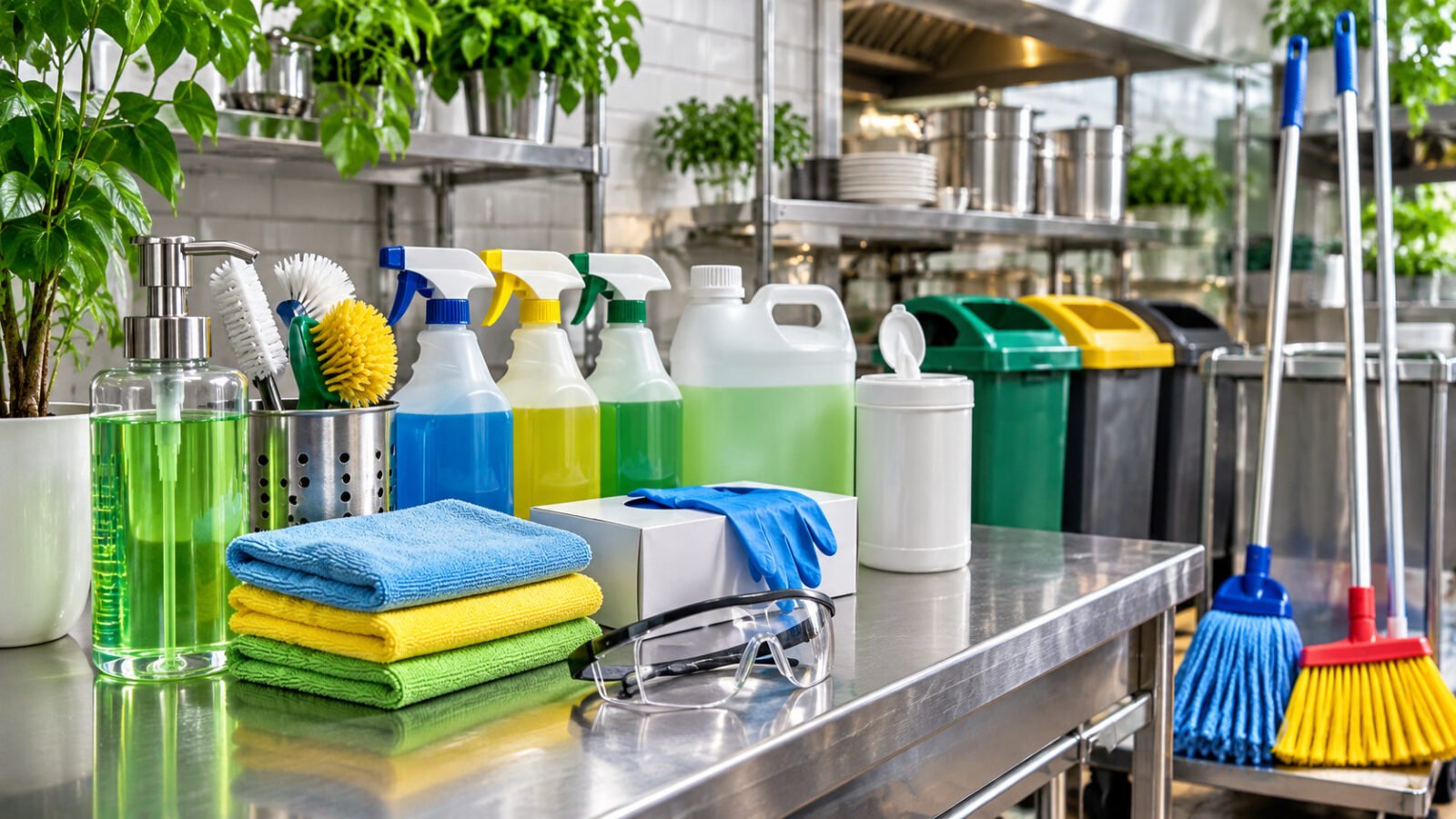
Surface-care essentials can include appropriate detergents, degreasers, scrub pads, microfiber cloths, wiping systems and food-area-approved sanitizing products. Choose by the surface and soil type, not by a generic “all-purpose” claim.
Match the cleaner to the surface
Stainless-steel counters, food-contact prep tables, cooking equipment, walls and floors can need different methods. Harsh or abrasive materials may damage certain finishes. Check the equipment manufacturer’s cleaning instructions before using a product on nonstick coatings, stone, aluminum or sensitive machinery. For food-contact surfaces, verify the stated food-area suitability and any rinsing requirements.
A good everyday routine usually distinguishes removal of visible residue, cleaning with the intended product and any additional sanitizing step that is required. Contact times for sanitizers or disinfectants vary by product: do not wipe them off too early or invent a universal exposure period. Follow the label and the procedure relevant to your business.
Reusable cloths and cleaning zones
Microfiber cloths can be practical for many tasks if cleaned and replaced appropriately. Some kitchens use color coding to separate tasks, but a color does not guarantee hygiene by itself. Define which cloths belong in food-prep, restroom and floor-cleaning areas, and make the system easy for staff to follow. Store used materials separately from clean supplies.
When evaluating a large pack, check fabric quality, laundering guidance, unit count and whether the cloth is compatible with the chemicals used in your facility. Buying inexpensive cloths that quickly deteriorate can create waste instead of savings.
2. Hand Hygiene & Sanitation
Hand hygiene depends on more than a soap dispenser. Conveniently placed handwashing facilities, appropriate soap, suitable drying materials and clear routines make a difference. In food operations, handwashing requirements are governed by applicable local rules; hand sanitizer is not automatically a substitute for washing hands with soap and water.
Choose dispensers that fit the workflow
Compare wall-mounted dispensers, countertop pump bottles and refill systems by cleaning access, replacement supplies, dispenser capacity and where they can be installed. A sealed refill system may be easier to manage in some settings, while a simple pump may be sufficient for a small home kitchen.
Paper towels, hygienic drying options and a practical waste bin are often part of the same handwashing station. Consider how frequently a station must be replenished during a busy service. Staff should not need to cross food preparation areas to find basic handwashing supplies.
Be careful with sanitation claims
“Antibacterial,” “hospital-grade,” “food safe,” and “kills 99.9%” are claims tied to particular products, test conditions and jurisdictions. Do not assume all soaps, wipes and sanitizers have the same use instructions or approvals. Check current labeling, relevant registrations where required and the applicable instructions before purchasing for professional use.
3. Food Safety & Protective Gear
Protective equipment helps manage specific work hazards, but it must be suitable for the task. Gloves, aprons, eyewear, non-slip footwear, cut-resistant gloves and food-handling tools solve different problems. No single product makes an entire workplace safe.
Gloves are task-specific
Food-handling gloves, heat-resistant gloves, cut-resistant gloves and chemical-resistant gloves are not interchangeable. Check fit, material, intended protection, and any manufacturer limitations. Food-handling gloves still require appropriate hand hygiene and should be changed as needed to avoid cross-contamination. Chemical-resistant gloves must match the chemicals used, based on the safety information and manufacturer guidance.
Cut-resistant gloves may help with some slicing tasks but are not universally suitable for every blade or machine. Equipment guards, staff training and safe working methods remain essential. Likewise, eye protection should be selected for the relevant splash or impact hazard rather than purchased solely on appearance.
Footwear and aprons
For restaurants, compare slip-resistant work shoes with attention to fit, comfort, cleaning requirements and the relevant work environment. Aprons can protect clothing from splashes or spills but are not a replacement for hazard-specific PPE. Home users can apply the same task-based thinking on a smaller scale.
If a product advertises compliance with a safety standard, check the exact standard, certification scope and intended use. Local occupational and food-safety requirements may be different from those described by an overseas Amazon listing.
4. Waste Management & Cleaning Tools
Well-organized waste management can make a kitchen easier to clean and reduce clutter. Typical products include step bins, liners, recycling stations, compact waste containers, floor squeegees, mops, dustpans and long-handled brushes.
Choose bins by capacity and placement
Start with the expected volume and type of waste. A food-prep area may need a compact, easy-to-clean bin that fits an appropriate location, while a larger back-of-house area may need more capacity and a system for separating recyclable materials where local collection supports it. Consider lid operation, liner size, wipe-clean surfaces and how the bin is emptied.
Do not assume that color-coded bins alone guarantee compliant waste segregation. Use labels and instructions that reflect your actual local collection rules. Keep waste equipment positioned so it does not interfere with safe movement, food handling or handwashing access.
Floor-care equipment
Wet floors can be a slip hazard. Select mops, squeegees and brushes according to floor type and the cleaning process, and follow your workplace procedures for spills and access to affected areas. Separate tools used in restrooms or external areas from those intended for kitchen work. Store tools so they can dry as recommended and remain easy to inspect.
A practical purchasing comparison
When comparing products, include total usability rather than just the advertised pack price. A refillable dispenser has ongoing refill costs. A protective glove has replacement and sizing requirements. A mop needs cleaning, drying and storage. Bulk cases require room and may be unsuitable if products expire or are rarely used.
| Product group | What to check | Common mistake |
|---|---|---|
| Surface cleaner | Intended surface, dilution, contact time and rinse instructions | Using an unsuitable product on food-contact surfaces |
| Handwashing supplies | Dispenser compatibility and refills | Buying incompatible refill cartridges |
| Protective gloves | Task, size, chemical/material compatibility | Assuming all gloves protect against every hazard |
| Waste bins | Capacity, cleaning access, liner fit and placement | Ignoring real workflow and space |
| Reusable tools | Care instructions, durability and storage | Reusing tools across incompatible cleaning zones |
For a fair comparison, estimate a monthly cost of use: expected quantity used, necessary refills and replacements, shipping and storage. Do not copy current prices from Amazon unless you have an authorized and compliant method for displaying them. Product prices and availability can change.
Restaurant kitchen versus home kitchen: what changes?
The principles of selecting appropriate equipment and following instructions apply in both places, but a professional food business normally has additional obligations. Staff training, documented routines, sanitation procedures, inspections, occupational protection and applicable local codes require more than a shopping list. A home kitchen may need smaller packages and fewer dedicated stations, but it still benefits from correctly stored chemicals, appropriate cloth separation and clean food-contact equipment.
When an Amazon product is marketed for professional use, check the supplier’s specifications carefully. A retail listing is not proof that an item meets every local health, food-contact or workplace requirement.
Buying checklist before placing an order
- List the areas to be cleaned and the actual tasks performed.
- Confirm each product’s intended use and compatibility with surfaces or equipment.
- Read labels for dilution, contact time, rinsing, storage and safe handling.
- Keep cleaning chemicals away from food and never combine products.
- Choose gloves and protective equipment for the specific hazard.
- Match dispenser models with the correct refill sizes.
- Check bin dimensions, capacity and liner compatibility.
- Plan separate storage for clean supplies and used cleaning equipment.
- Compare total operating costs rather than single pack prices.
- Follow applicable food-safety, occupational and waste-disposal requirements.
Five mistakes that make cleaning supplies harder to manage
Buying too many product types: overlapping supplies complicate storage and instructions. Ignoring compatibility: a product may damage equipment or fail to work as intended. Missing refill planning: dispensers become useless if the matching refill is unavailable. Mixing cleaning zones: using one cloth or brush everywhere can undermine the process. Treating protective gear as a complete solution: appropriate equipment still needs training, safe processes and maintenance.
Frequently asked questions
What cleaning supplies should a small restaurant buy first?
Start with appropriate cleaners for your actual surfaces, handwashing supplies, clearly assigned reusable tools, suitable waste bins and any protective gear identified by your workplace risks and local requirements. Keep a simple inventory rather than buying everything at once.
Can I use ordinary household cleaners in a restaurant kitchen?
Only if the specific product is suitable for the intended task, surfaces and setting and meets applicable requirements. Review the label, relevant food-contact instructions and local rules before using it professionally.
Do disposable gloves replace handwashing?
No. Gloves do not replace appropriate hand hygiene, and they need to be selected and changed according to the task and relevant procedures.
How can I choose a food-area sanitizer?
Verify that the product is intended for the relevant surface and use, then follow its exact instructions, including preparation, contact time and rinsing where specified. Consult local food-safety guidance for your business.
Is an eco-friendly cleaning product always safer?
Not necessarily. Environmental claims and human-safety claims are different. Look for substantiated product information and follow the label regardless of marketing language.
Does Habesha Studio ship cleaning products directly?
No. Habesha Studio offers buying guidance and links to external retailers. Verify product specifications, current prices, shipping and return conditions with the seller before purchasing.
Build a simple, reliable cleaning supply system
A dependable cleaning setup combines suitable products with clear routines. Choose supplies around your operations, verify compatibility and safety instructions, keep inventory manageable and review the system regularly. Start with the four practical shopping collections rather than unnecessary subcategories.
Shop Cleaning, Hygiene & Safety Essentials or browse other equipment and supplies in the Habesha Shopping Center.
Affiliate disclosure: As an Amazon Associate, Habesha Studio earns from qualifying purchases. This guide includes general shopping advice; retailer links may be affiliate links. Product availability, prices and purchase conditions are determined by the seller. This article is not a substitute for manufacturer instructions, professional training or applicable health and safety requirements.