

There are places that impress you immediately, and there are places that slowly change the way you understand a country. Lalibela belongs to the second group.
High in the Ethiopian mountains, Lalibela is home to an extraordinary collection of medieval churches cut directly from solid rock. From ground level, parts of the complex almost disappear into the landscape. Walk closer and walls, courtyards, passages, doorways and complete church buildings begin to emerge below your feet.
Yet Lalibela is much more than an archaeological attraction. The churches remain sacred places of worship. Priests pray here, worshippers attend services, pilgrims travel long distances to reach the holy city, and major Ethiopian Orthodox celebrations continue to fill the churches and surrounding passages with religious life.
Lalibela is simultaneously history, architecture, faith and a living Ethiopian community.
Why Lalibela Is So Extraordinary
Most monumental buildings begin with an empty space and rise upward. Lalibela reverses that idea. Craftspeople worked down into the existing volcanic rock, removing material until buildings, windows, doors, pillars, floors and roofs emerged from the stone.
The work did not stop with individual churches. Trenches, courtyards, drainage channels and passages connect parts of the sacred landscape. This creates an experience unlike visiting a conventional church or monument: you descend into the site, move between high rock walls and suddenly discover another structure carved into the earth.
A Sacred “New Jerusalem” in Ethiopia
The story of Lalibela is closely associated with King Lalibela of the Zagwe dynasty. The religious landscape came to be understood as a symbolic “New Jerusalem,” with names and features that connect the site to biblical geography. A watercourse traditionally identified with the River Jordan separates the principal groups of churches.
This symbolism helps explain why Lalibela became far more than an architectural project. It developed into a sacred geography where Ethiopian Christian tradition, biblical memory and the physical landscape meet.
The Eleven Rock-Hewn Churches of Lalibela
The UNESCO World Heritage complex contains eleven medieval rock-hewn churches. They are generally understood as two principal groups, with Biete Ghiorgis standing separately.
North of the Jordan are Biete Medhani Alem, Biete Mariam, Biete Maskal, Biete Denagel and Biete Golgotha Mikael. South of it are Biete Amanuel, Biete Qeddus Mercoreus, Biete Abba Libanos, Biete Gabriel Raphael and Biete Lehem. The isolated Biete Ghiorgis — the Church of St George — is connected to the wider complex through trenches and passages.
Biete Medhani Alem
Biete Medhani Alem, the House of the Saviour of the World, gives visitors an immediate sense of the scale of Lalibela. UNESCO describes it as a five-aisled church and notes that it is believed to be the largest monolithic church in the world.
The achievement becomes even more striking when you remember how it was created: rather than assembling blocks, builders removed huge amounts of rock while carefully preserving the sections that would become the church itself.
Biete Mariam
Biete Mariam, or the House of Mary, is one of the best places to appreciate the more intimate and devotional side of Lalibela. The site is not only about engineering. Interior spaces, religious decoration and centuries of worship reveal how architecture and faith developed together.
Biete Golgotha Mikael
The biblical symbolism becomes especially strong around Biete Golgotha Mikael. Religious references associated with Christ, Adam and the Holy Land form part of the wider sacred geography of Lalibela. This is why the description of Lalibela as an Ethiopian “New Jerusalem” is more than a tourism slogan.
Biete Amanuel
Biete Amanuel demonstrates the sophistication possible in rock-hewn architecture. Its carefully articulated façade shows that carving from a single mass of stone did not require architectural simplicity. Recessed surfaces, openings and geometric details give the church a distinctive presence.
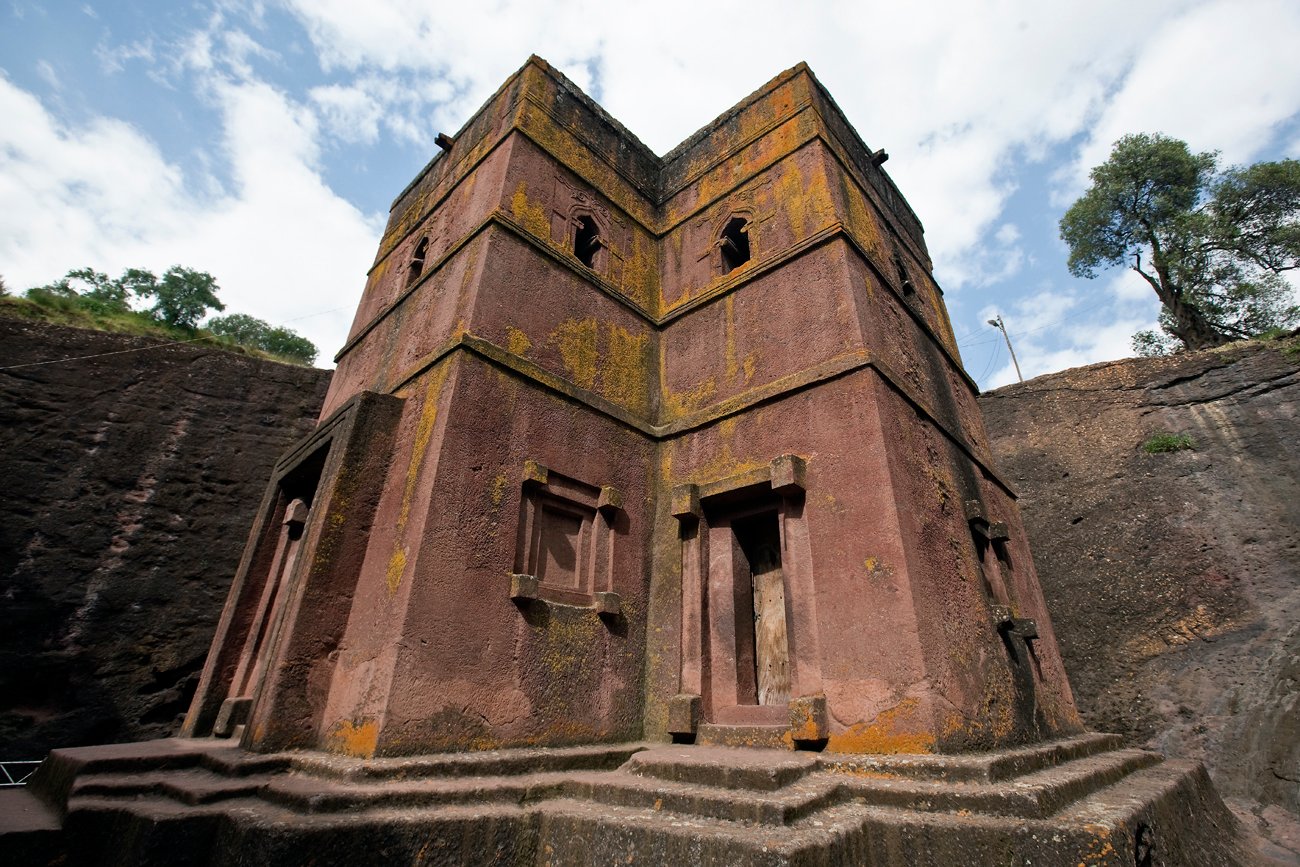
Biete Ghiorgis – The Icon of Lalibela
For many visitors, Biete Ghiorgis, the Church of St George, is the image that defines Lalibela. Seen from above, its cross-shaped roof appears inside a deep excavation. The church rises from the central mass of rock that remained after the surrounding stone was removed.
The perspective is part of the experience. You first encounter the building from above and then descend until the complete church rises in front of you. Photographs make Biete Ghiorgis famous, but standing within the excavated space reveals the true scale of the work.
Lalibela Is Not an Abandoned Monument
This is perhaps the most important thing to understand before visiting. Lalibela is alive.
The churches remain active religious sites and Lalibela continues to be an important centre of Ethiopian Orthodox Christian pilgrimage and devotion. Visitors may encounter priests dressed in white, worshippers praying against ancient walls or people removing their shoes before entering a church.
For travellers, Lalibela is heritage. For believers, it is holy. Respecting that difference makes a visit considerably richer.
Christmas and Religious Life in Lalibela
The spiritual importance of the town becomes especially visible during major religious festivals. Ethiopian Christmas, known as Genna, brings pilgrims to Lalibela for worship and ceremonies. White traditional clothing fills the rock-cut spaces, prayer continues through the sacred landscape and the churches become the centre of an extraordinary living religious gathering.
Timkat, the Ethiopian celebration of Epiphany, is another major part of the country’s Orthodox Christian calendar. Visitors travelling during religious festivals should remember that worship comes before sightseeing.
Beyond the Churches
Lalibela should not be reduced to eleven churches. The surrounding highland landscape, traditional settlements and everyday life are part of the destination. Traditional circular dwellings and the dramatic mountain environment help place the churches within a much broader Ethiopian cultural landscape.
A morning among medieval churches can lead into a landscape of farms, villages and mountain paths. Spending more than a few hours in Lalibela makes it easier to see the town as a living community rather than a collection of monuments.
The Human Side of Lalibela
The most memorable moments are not always the ones marked on a map. It may be the sound of prayer early in the morning, a conversation over Ethiopian coffee, a priest disappearing through a doorway cut into stone, or the sudden silence of an underground passage after the bright highland sun.
These moments remind visitors that Lalibela did not stop existing when the churches became internationally famous. Families live and work here. Faith continues here. Tourism is only one part of the town’s identity.
Protecting a Fragile World Heritage Site
The same rock that made Lalibela possible also creates conservation challenges. Water, drainage, weathering and structural deterioration can threaten ancient surfaces and buildings. Protective structures have been introduced over some churches, while conservation specialists continue to balance preservation with the visual and religious character of the site.
Visitors can help in simple ways: follow local instructions, respect barriers, avoid touching fragile surfaces and never prioritize a photograph over preservation or worship.
When to Visit Lalibela
There is no single perfect season because the experience changes with weather and the religious calendar. Travellers primarily interested in architecture may appreciate quieter periods, while those interested in Ethiopian Orthodox culture may choose to visit around major celebrations such as Genna or Timkat.
Festival periods can be extraordinary, but they also require more planning because the town receives many pilgrims and visitors.
How Long Should You Stay?
A single day can introduce the principal churches, but two or three days gives a much better sense of Lalibela. This allows time to explore both church groups, visit Biete Ghiorgis without rushing, experience the town at different times of day and leave room for local food, coffee and the surrounding highlands.
Visiting the Churches Respectfully
Dress respectfully, follow instructions about photography and remove shoes where required. Ask before photographing people closely, particularly priests, monks and pilgrims. During ceremonies, worshippers should always have priority.
A knowledgeable local guide can add valuable context by explaining the relationships between biblical symbolism, Ethiopian history, individual churches and local traditions that are easy to miss when walking alone.
Lalibela and Ethiopian Food
Exploring Lalibela is also an opportunity to experience Ethiopian hospitality. Injera served with stews, legumes and vegetable dishes offers a natural pause between visits to the churches. Ethiopian coffee deserves its own time: a traditional coffee ceremony is a social and cultural experience, not simply a quick drink.
For HabeshaStudio, this connection matters. Ethiopian architecture, religion, food and community are not isolated subjects. They overlap and together tell a much richer story about Ethiopia and the global Habesha community.
Why Lalibela Matters Beyond Ethiopia
Lalibela is deeply Ethiopian, but its cultural significance is international. The Rock-Hewn Churches of Lalibela were inscribed on the UNESCO World Heritage List in 1978. UNESCO recognizes the eleven medieval churches, the site’s remarkable artistic achievement and its continuing importance as a place of pilgrimage and devotion.
A Place That Should Not Be Reduced to a Photograph
Many people first encounter Lalibela through a photograph of the cross-shaped Biete Ghiorgis viewed from above. It is an unforgettable image, but Lalibela is much larger than that photograph.
It is eleven churches, trenches cut through stone, passages disappearing underground, medieval Ethiopian history, generations of craftsmanship, priests, monks, pilgrims and a living highland community.
The remarkable thing about Lalibela is not simply that these monuments survived. It is that the place never became only a monument.
Frequently Asked Questions About Lalibela
Where is Lalibela?
Lalibela is a historic town in the mountainous highlands of northern Ethiopia and one of the country’s most important Christian pilgrimage centres.
How many rock-hewn churches are in Lalibela?
The UNESCO World Heritage complex contains eleven medieval rock-hewn churches.
Who built the Lalibela churches?
The churches are traditionally associated with King Lalibela of the Zagwe dynasty and with the creation of a symbolic New Jerusalem in Ethiopia.
Are the churches still used?
Yes. The churches remain active religious sites and continue to receive worshippers and pilgrims.
What is the most famous church in Lalibela?
Biete Ghiorgis, the Church of St George, is the most internationally recognizable because of its cross-shaped plan and dramatic rock-cut setting.
Is Lalibela a UNESCO World Heritage Site?
Yes. The Rock-Hewn Churches of Lalibela were inscribed on UNESCO’s World Heritage List in 1978.
Sources and further reading: UNESCO World Heritage Centre, “Rock-Hewn Churches, Lalibela”; Wikimedia Commons image licensing information.
Featured image: Bete Giyorgis, Lalibela, Ethiopia — photo by Hulivili, licensed under CC BY 2.0, via Wikimedia Commons.