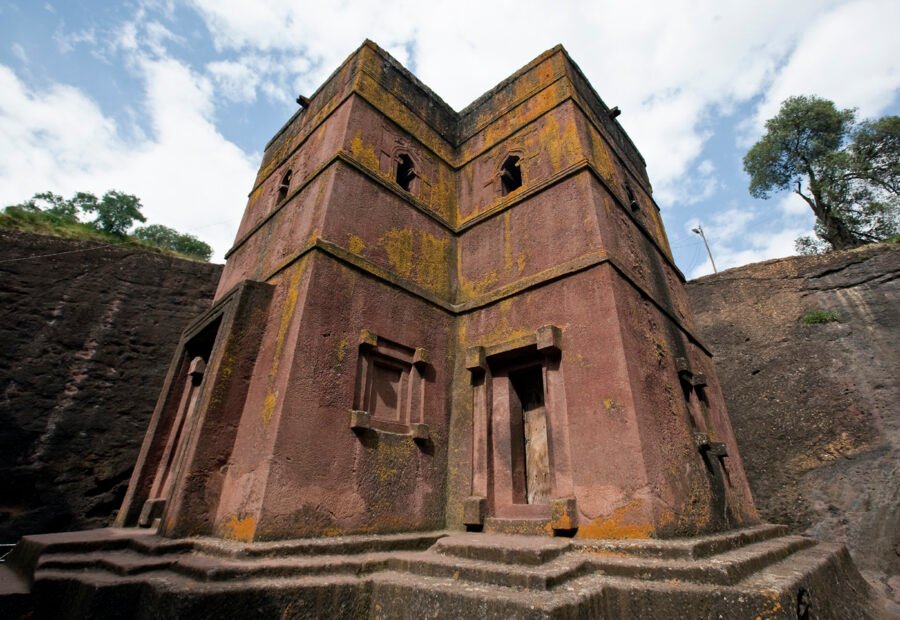

Aksum, Ethiopia is one of Africa’s great historic cities: a living place where monumental stone stelae, royal tombs, ancient inscriptions, coins and Christian traditions preserve the memory of a kingdom that once connected the African interior with the Red Sea, Arabia and the wider Mediterranean world.
Known internationally as both Aksum and Axum, the city lies in the Tigray highlands of northern Ethiopia. UNESCO describes ancient Aksum as the heart of a powerful civilization positioned at the crossroads of Africa, Arabia and the Greco-Roman world. Its surviving monuments are not simply isolated ruins: together they tell a story of trade, state power, writing, engineering, religion and cultural continuity spanning many centuries.
Aksum at a glance
- Country: Ethiopia
- Region: Tigray
- Historic role: Capital and ceremonial centre of the Aksumite Kingdom
- World Heritage: UNESCO World Heritage Site since 1980
- UNESCO criteria: (i) and (iv)
- Famous for: monumental stelae, royal tombs, inscriptions, ancient coins and the Church of Saint Mary of Zion
- Historic connections: Red Sea trade, Adulis, Arabia, the Nile region and the Mediterranean world
Why Aksum matters in African and world history
Aksum’s importance comes from the scale and reach of the civilization centred there. Between the early centuries of the Common Era and late antiquity, Aksum developed into a major political and commercial power. UNESCO characterizes the kingdom as a dominant state between the Eastern Roman Empire and Persia, while archaeological evidence shows a society capable of monumental construction, long-distance commerce, minting its own coinage and using several written languages.
The city’s position was crucial. Inland routes connected the highlands with northeast Africa, while the Red Sea port of Adulis linked Aksumite commerce to maritime networks. Ivory, gold and other products moved outward; manufactured goods and textiles moved inward. This exchange placed Aksum within a much larger economic world rather than at its edge.
The Kingdom of Aksum: from regional centre to international power
The exact chronology of Aksum’s earliest development continues to be refined by archaeology. What is clear is that by the first centuries AD, Aksum had become the centre of an increasingly sophisticated kingdom. Its rulers projected authority through inscriptions, monumental architecture and coinage. The kingdom’s influence extended across parts of the northern Ethiopian and Eritrean highlands and, at different moments, across the Red Sea into South Arabia.
Aksumite coins are especially valuable to historians because they provide names and images of rulers, royal titles, religious symbols and evidence of commercial connections. Gold, silver and bronze issues demonstrate a developed monetary culture. Changes in coin imagery also help document the kingdom’s religious transformation, including the appearance of the Christian cross in the fourth century.
King Ezana and the adoption of Christianity
One of the best-known Aksumite rulers is King Ezana, whose reign in the fourth century is associated with the kingdom’s adoption of Christianity. This was a major turning point. Christianity became deeply embedded in Ethiopian history and remains central to Aksum’s identity today.
Stone inscriptions connected with Ezana are among Aksum’s most important historical documents. UNESCO highlights texts written in Greek, Sabaean and Geʽez, demonstrating both the multilingual environment of the kingdom and the value of Aksum’s inscriptions for understanding late antiquity.
The stelae of Aksum: engineering in stone
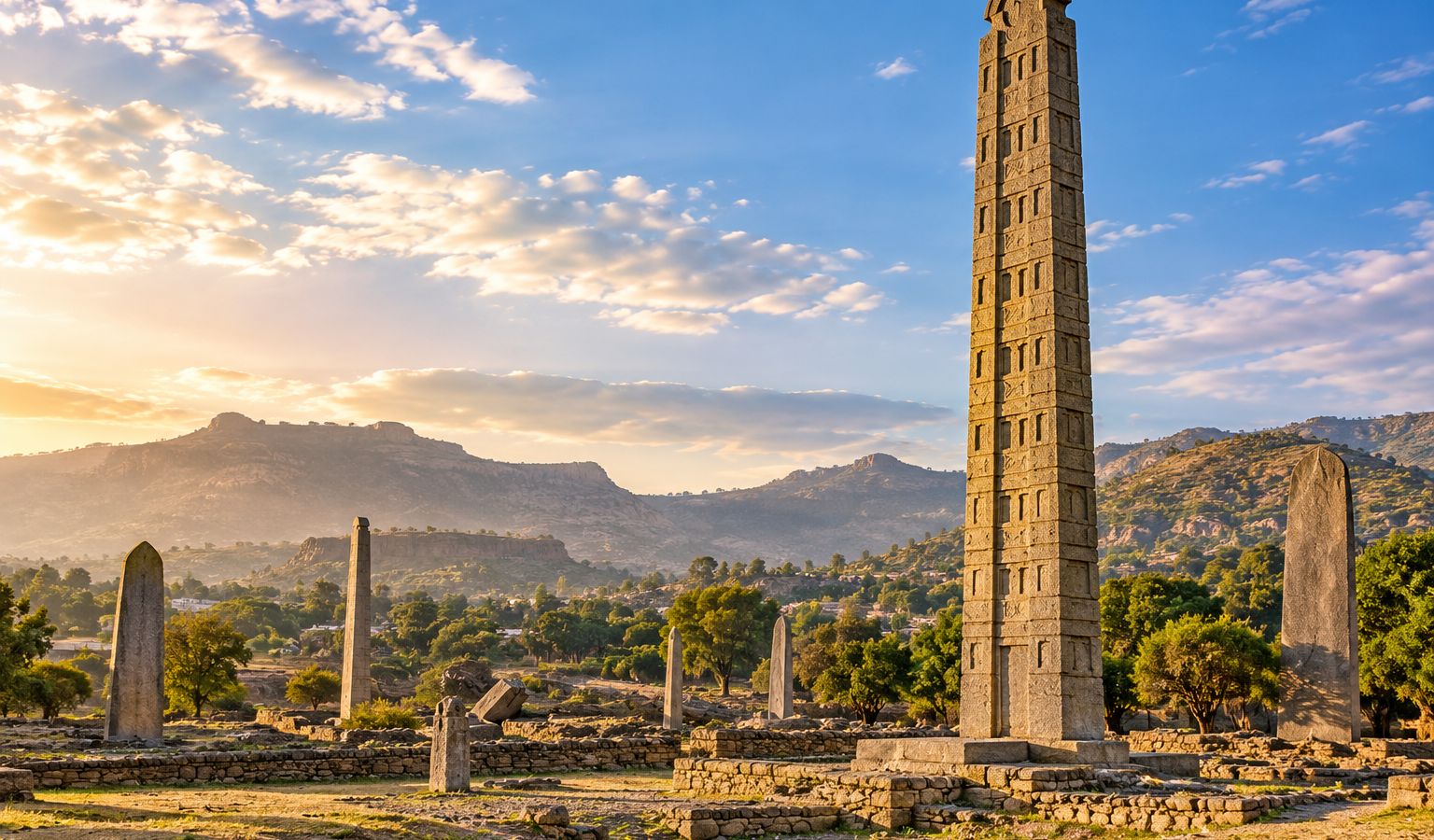
The monumental stelae of Aksum are the city’s most recognizable archaeological remains. These enormous monoliths were carved from single pieces of stone and were associated with elite funerary landscapes. Some imitate multi-storey buildings in stone, complete with carefully carved false doors, windows and architectural details.
UNESCO records that the largest standing decorated stele rises more than 23 metres. An even larger fallen monument, approximately 33 metres long, represents one of the most ambitious monolithic stone projects attempted in the ancient world. Their scale raises enduring questions about quarrying, transport, carving and erection — and makes the stelae powerful evidence of Aksumite organization and engineering skill.
The Obelisk of Aksum: removal, return and re-erection
One of Aksum’s major stelae was removed during the Italian occupation and taken to Rome in 1937. Decades later, the monument was returned to Ethiopia in 2005. UNESCO supported the complex archaeological and engineering work surrounding its return, and the stele was re-erected at Aksum in 2008.
The episode gave the monument a second history. Beyond its ancient funerary meaning, its return became closely connected with cultural heritage, restitution and national memory. Archaeological surveys undertaken around the reinstallation also revealed underground chambers and other structures, showing how much of ancient Aksum may still remain below the modern surface.
Royal tombs and the archaeology beneath the city
Aksum is much more than its visible stelae. Royal tombs, masonry structures, palace remains, inscriptions, ceramics and buried architecture form a broad archaeological landscape. UNESCO reported that non-destructive surveys near the main stelae field identified extensive subterranean funerary chambers. Such discoveries reinforce an important point: the modern city stands within and above a much larger ancient settlement.
That overlap creates both opportunities and conservation challenges. Archaeologists can investigate an exceptionally rich urban site, but modern construction, drainage, tourism infrastructure and everyday city life must coexist with fragile remains. UNESCO has repeatedly emphasized the importance of documentation, boundaries, planning controls and conservation management.
Saint Mary of Zion and Aksum’s sacred importance
Aksum is not only an archaeological destination. It remains one of the most important sacred centres of Ethiopian Orthodox Christianity. The Church of Saint Mary of Zion is central to that religious landscape. The present historic church complex reflects later rebuilding, while the tradition of a major church at Aksum reaches back to the Christianization of the kingdom.
Ethiopian Orthodox tradition holds that the Ark of the Covenant is kept at Aksum. This is a matter of religious belief rather than an archaeologically verified claim, and the distinction is important. Regardless of how the tradition is approached, it has made Aksum a major place of pilgrimage and gives the city a living spiritual significance extending far beyond its ancient ruins.
Aksum and the early history of Islam
Aksum also appears in traditions concerning the earliest history of Islam. Historical accounts describe followers of the Prophet Muhammad seeking refuge in the Aksumite realm during the first hijra in the early seventh century. The ruler, commonly identified in Islamic tradition by the title al-Najashi (the Negus), is remembered for granting them protection.
This episode adds another layer to Aksum’s significance: the kingdom occupied a world in which African, Arabian, Christian and emerging Islamic histories were closely connected across the Red Sea.
Trade, Adulis and Aksum’s international connections
Aksum’s prosperity cannot be understood without the Red Sea. The port of Adulis, on the coast of present-day Eritrea, served as a major maritime outlet. From the highlands, routes connected Aksum with the Nile region, gold-producing areas, the Horn of Africa and the Red Sea coast. Maritime commerce then opened connections toward Arabia, the Mediterranean and the Indian Ocean.
This network helps explain why imported objects, foreign languages and internationally recognizable monetary forms appear in the Aksumite record. Aksum was African at its core while also participating actively in interregional exchange — a combination that makes it essential to a fuller understanding of the ancient world.
Geʽez, inscriptions and written history
Written evidence is one of Aksum’s great strengths. Royal inscriptions preserve political and religious messages, while the use of Geʽez links the ancient kingdom to a literary and liturgical language that would have a long life in Ethiopia and Eritrea. Greek and South Arabian scripts in the epigraphic record reflect the kingdom’s wider contacts.
For historians, these inscriptions are especially valuable when read together with coins and archaeology. No single source tells the whole story. The strongest reconstruction of Aksum’s past comes from combining texts, material remains, landscape studies and evidence from neighbouring regions.
From political decline to enduring cultural centre
Aksum’s political power eventually declined as regional trade and political structures changed. Yet the city did not disappear from Ethiopian history. UNESCO notes that Ethiopian emperors continued to be crowned there long after the ancient kingdom’s political decline. Its religious prestige and association with earlier kingship allowed Aksum to remain a powerful symbol of continuity.
UNESCO World Heritage status
Aksum was inscribed on the UNESCO World Heritage List in 1980 under criteria (i) and (iv). UNESCO recognizes the carved monolithic stelae as exceptional works of human creative achievement and the wider ensemble of monuments as outstanding evidence of Aksumite civilization.
World Heritage recognition also brings attention to preservation. The archaeological property faces continuing pressures from urban growth, construction, water and drainage problems, incomplete documentation and the challenge of protecting buried remains within a living city. Conservation is therefore not only about repairing individual monuments; it also involves managing the relationship between heritage, residents, infrastructure and future development.
What to see in Aksum
- Northern Stelae Field: the best-known concentration of monumental Aksumite stelae.
- The re-erected Aksum stele: returned from Rome and restored to the archaeological landscape.
- The Great Stele: the enormous fallen monolith that demonstrates the scale of Aksumite stoneworking.
- Royal tomb areas: funerary structures associated with Aksum’s elite.
- Saint Mary of Zion complex: a central place in Ethiopian Orthodox tradition.
- Ezana-related inscriptions: key evidence for Aksumite kingship, language and religion.
- Archaeological and historical collections: useful for understanding coins, inscriptions and everyday material culture.
Aksum today: a living city, not an open-air museum
It is easy to describe Aksum only in the past tense, but that misses something fundamental. Modern Aksum is a living Ethiopian city whose residents, churches, streets and institutions share space with an archaeological landscape of global importance. Heritage here is part of daily life.
For visitors, that means approaching Aksum with respect. Sacred spaces should be treated as active places of worship, not simply attractions. Archaeological areas should be visited without climbing on or removing material from monuments, and local rules regarding photography and access should always be followed.
Aksum, food and Habesha culture
The history of Aksum also belongs to the wider story of Habesha culture. For readers discovering Ethiopia and Eritrea through food, restaurants and community life, understanding places such as Aksum adds depth to the experience. Cuisine, language, faith, migration, trade and memory all form parts of a much larger cultural story.
Discover Habesha culture near you
Explore Ethiopian and Eritrean restaurants, cafés and businesses around the world on HabeshaStudio.
Frequently asked questions about Aksum
Where is Aksum?
Aksum is in the Tigray Region of northern Ethiopia, in the northern Ethiopian highlands.
Why is Aksum famous?
Aksum is famous as the centre of the ancient Aksumite Kingdom and for its monumental stelae, royal tombs, inscriptions, coinage and major place in Ethiopian Christian tradition.
Is Aksum a UNESCO World Heritage Site?
Yes. Aksum was inscribed on the UNESCO World Heritage List in 1980 under criteria (i) and (iv).
How old are the Aksum stelae?
The best-known monumental stelae date mainly to the third and fourth centuries AD, although the wider archaeological landscape spans a much longer period.
Was the Obelisk of Aksum returned from Italy?
Yes. The stele taken to Rome during the Italian occupation was returned to Ethiopia in 2005 and re-erected at Aksum in 2008.
What religion was the Kingdom of Aksum?
Aksumite religion changed over time. Under King Ezana in the fourth century, Christianity was adopted by the kingdom and became a defining part of its later history.
Conclusion: why Aksum still matters
Aksum is important because it challenges narrow maps of the ancient world. Its history shows a powerful African state minting coins, raising extraordinary monuments, maintaining written traditions, participating in long-distance trade and shaping religious history on both sides of the Red Sea. At the same time, Aksum is not frozen in antiquity. It remains a living city and sacred landscape whose heritage continues to carry meaning today.
Sources and further reading
- UNESCO World Heritage Centre — Aksum
- UNESCO — Major archaeological discoveries in Aksum
- Stuart Munro-Hay, Aksum: An African Civilisation of Late Antiquity, Edinburgh University Press, 1991.
- Wolfgang Hahn, studies on the coinage of the Aksumite Empire.
Editorial note: Historical dates and interpretations of individual Aksumite rulers can vary between scholarly reconstructions. This article prioritizes established archaeological evidence and UNESCO documentation and distinguishes religious tradition from archaeological verification.