

A journey through the food, faith, language, and traditions that connect Ethiopia and Eritrea
When people talk about “Habesha culture,” they’re referring to one of the richest and most distinctive cultural identities in East Africa — a heritage shared by the peoples of Ethiopia and Eritrea. The word “Habesha” describes a shared cultural and linguistic identity that stretches back thousands of years, rooted in ancient kingdoms, unique religious traditions, and a way of life that continues to shape communities both in the Horn of Africa and across the diaspora today.
Whether you’re researching your own heritage, planning to visit the region, or simply curious about a culture with such deep historical roots, this guide walks through the traditions, values, and customs that define Habesha identity.
What Does “Habesha” Mean?
The term “Habesha” traditionally refers to the Semitic-speaking peoples of the Ethiopian and Eritrean highlands, including groups such as the Amhara, Tigrayans, and Tigrinya. Over time, the word has grown to represent a broader cultural identity — one built around shared language roots, religious history, cuisine, and social customs rather than strict ethnic lines.
Today, “Habesha” is often used as a unifying term of pride, especially within diaspora communities in the United States, Europe, and the Middle East, where Ethiopians and Eritreans frequently come together around shared cultural touchpoints.
Ancient Roots: The Kingdom of Aksum
Habesha history stretches back to the Kingdom of Aksum, one of the great civilizations of the ancient world. Aksum was a major trading power between the 1st and 7th centuries, minting its own currency and maintaining trade relationships with Rome, Persia, and India. It was also one of the first kingdoms in the world to officially adopt Christianity, in the 4th century — a fact that still shapes Habesha religious life today.
This ancient foundation is part of why Habesha culture carries such a strong sense of historical identity: it’s one of the few regions in the world with an unbroken written and religious history stretching back over a thousand years, distinct from European colonial influence.
Religion and Spirituality
Religion plays a central role in Habesha life. The Ethiopian Orthodox Tewahedo Church and the Eritrean Orthodox Tewahedo Church are among the oldest Christian institutions in the world, with practices, calendars, and fasting traditions that differ from Western Christianity. Islam also has deep historical roots in the region, particularly in eastern Ethiopia and parts of Eritrea, with some of the earliest mosques in Africa found here.
Religious holidays are major cultural events. Timkat (Ethiopian Epiphany), Meskel (the Finding of the True Cross), and Fasika (Orthodox Easter) are celebrated with processions, music, and community gatherings that draw entire towns together.
The Coffee Ceremony: A Cultural Cornerstone
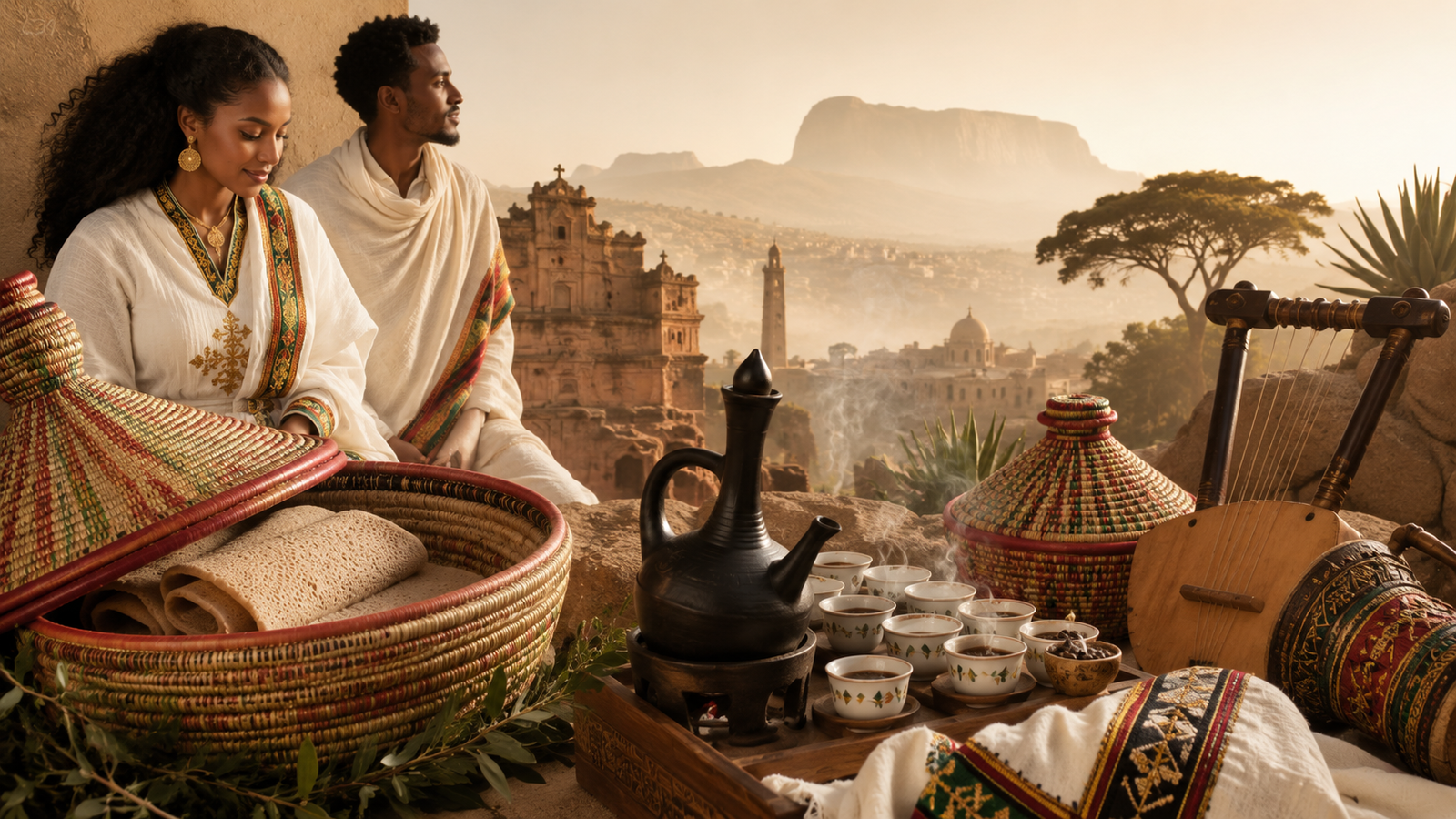
No discussion of Habesha traditions is complete without the coffee ceremony. Ethiopia is widely regarded as the birthplace of coffee, and the ceremony itself is a ritual of hospitality, community, and patience. Green coffee beans are roasted by hand in front of guests, ground, and brewed in a clay pot called a jebena, then served in small cups over multiple rounds.
The ceremony can take over an hour and is as much about conversation and connection as it is about the coffee itself. It remains one of the most enduring and recognizable Habesha customs, practiced daily in homes across Ethiopia, Eritrea, and diaspora communities worldwide.
Traditional Clothing
Habesha clothing is known for its elegant simplicity and craftsmanship. The habesha kemis — a traditional dress worn by women — is typically made from handwoven cotton called shema, often featuring colorful woven borders known as tibeb. Men traditionally wear a netela or gabi, lightweight woven garments draped over the shoulders.
These garments are worn regularly for religious holidays, weddings, and cultural celebrations, and they remain a proud symbol of identity, often passed down or gifted for special occasions.
Food and Cuisine
Habesha cuisine is built around injera, a spongy sourdough flatbread made from teff flour, which serves as both plate and utensil. It’s typically served with wat (stews) made from lentils, vegetables, or meat, seasoned with berbere, a complex spice blend central to the region’s cooking.
Meals are traditionally eaten communally from a shared plate, reinforcing values of togetherness and hospitality that run throughout Habesha culture.
Language and Identity
Amharic and Tigrinya are among the most widely spoken Habesha languages, both using the ancient Ge’ez script — one of the oldest alphabets still in use today. Language carries deep cultural weight, often serving as a marker of regional identity and a way of preserving oral history, proverbs, and poetry passed down through generations.
Habesha Culture in the Diaspora
As Ethiopian and Eritrean communities have grown across North America, Europe, and the Middle East, Habesha culture has evolved while staying rooted in tradition. Cultural associations, churches, restaurants, and community events help preserve customs like the coffee ceremony, traditional dress, and religious holidays, while also blending them with new influences — creating a vibrant, living culture rather than a static one.
Final Thoughts
Habesha culture is a living tradition shaped by ancient history, deep religious roots, and values of hospitality and community that show up in everything from a shared cup of coffee to a handwoven dress. Understanding these traditions offers a window not just into Ethiopian and Eritrean history, but into a culture that continues to thrive and evolve today, both at home and around the world.
Want to explore more about Habesha heritage, fashion, and traditions? Stay tuned for more deep dives into the culture that shapes who we are.
